What’s different about working with me?
My website is titled ‘Ali Pember - Therapy & Coaching’ because hopefully those labels are familiar. But you may be wondering exactly what it is that I do, and how it differs from help you may have received in the past. This post aims to explain a bit more about the way I work so you can see if it would be a good fit for you.
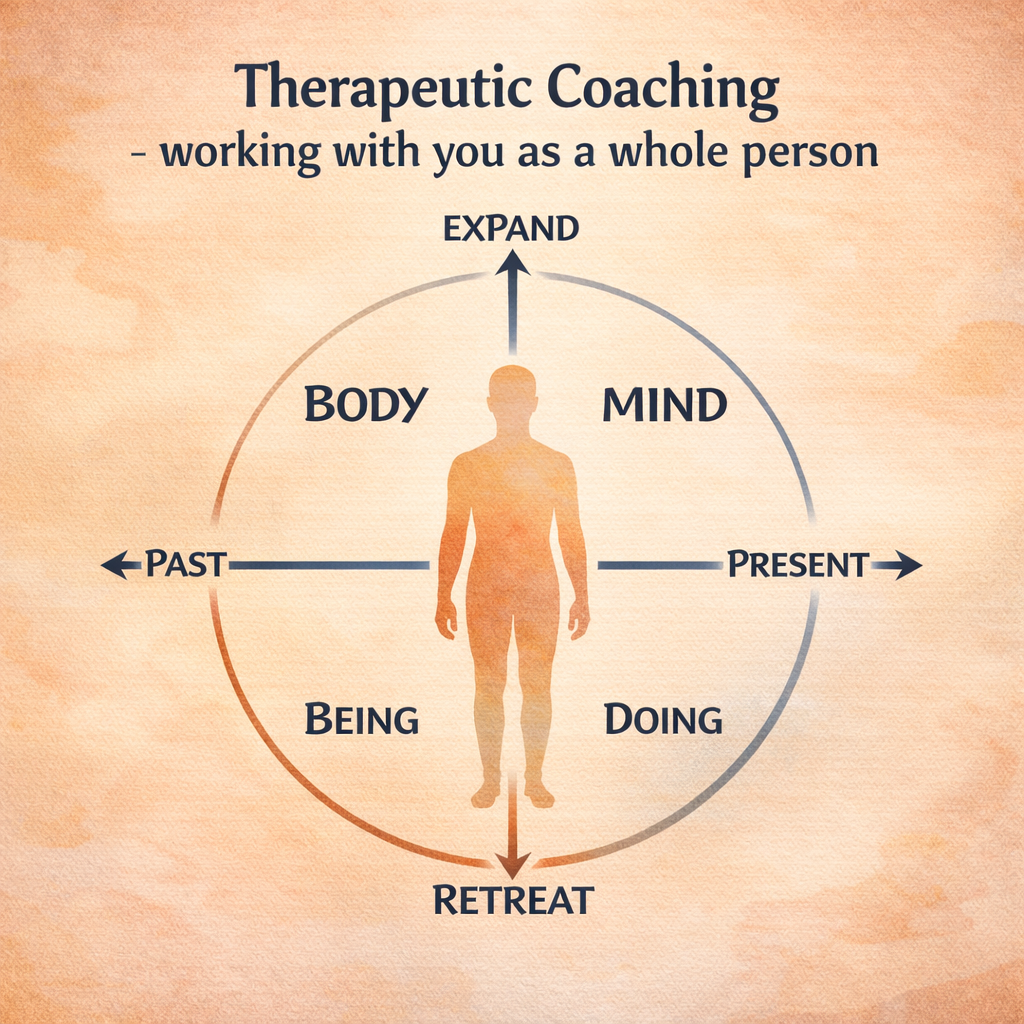
The main thing that I aim to do is work with you as a whole person - but what does that actually mean in practice?
If you've recently discovered - or begun to suspect - that you're autistic, ADHD, or both (AuDHD), you may have arrived here carrying a very particular kind of exhaustion. Not just tiredness, but the specific weight of a lifetime spent not quite understanding why things that seem easy for others have always felt so hard for you.
Maybe you've tried therapy before. Maybe it helped - a little, for a while. But perhaps you also found yourself going around in circles, talking about the same things week after week without anything really shifting. Or perhaps the structured, goal-focused approach of coaching felt energising at first, but didn't account for the deeper stuff underneath.
I want to offer something different. And to explain what that looks like, it helps to talk about three things I hold together in the way I work: Body and Mind; Being and Doing; Past and Present.
Body and Mind
Most of us - and this is especially true for late-discovered neurodivergent women - have spent our lives living almost entirely in our heads. Analysing, planning, masking, monitoring. Our bodies have often been treated as an afterthought, or worse, as something to push through and override.
But here's what I know from my background as a somatic coach, mindfulness teacher, and yoga instructor: lasting change doesn't happen through insight alone. It happens when the body is included in the conversation.
This doesn't mean anything strange or uncomfortable. It might be as simple as pausing mid-session to notice where you're holding tension, or using a grounding breath before we dive into something difficult. For some clients, it looks like EFT tapping - a technique that works with the body's energy system to help release stuck emotions or patterns that words alone can't reach. For others, it's developing a felt sense of what "regulated" actually feels like in their body, so they can begin to recognise - and move towards - safety more reliably.
The nervous system is at the heart of so much of what we experience as neurodivergent people. That constant hum of hypervigilance. The freeze when demands pile up. The crash after a period of overdrive. Understanding what's happening physiologically - and learning to work with it rather than against it - can be genuinely life-changing.
Being and Doing
One of the things that sets my work apart is that I hold space for both reflection and action. These aren't opposites - they're partners.
There's a version of therapy that is all being: gentle, exploratory, slow. And there's a version of coaching that is all doing: goals, action plans, accountability. Both have their place. But for many of my clients, neither alone is quite right.
Late-discovered neurodivergent women often have a complicated relationship with productivity and self-worth. There can be a lot of grief to sit with: for the years of not knowing, for the versions of yourself you masked into existence, for the support you didn't receive. That deserves space and care. At the same time, there's often a hunger to move forward, to finally build a life that actually fits, to stop forcing yourself through systems that weren't designed with you in mind.
I'm trained as a humanistic psychotherapist, which means I can safely hold complex, difficult emotional material with you - we won't avoid the deep stuff if it needs attending to. And I bring a coaching mindset to that work, which means we're always also asking: what next? You won't leave sessions just having talked. You'll leave with something to take with you: a tool, a reframe, a small but real step forward.
Past and Present
Something I hear often from clients is: "I know why I am the way I am. I just don't know how to change."
This is one of the places where a neurodivergent-informed approach really matters. It's not enough to understand your patterns intellectually. In fact, endlessly revisiting the past can sometimes do more harm than good, reactivating old pain without offering a way through it.
My approach is trauma-informed, which means I'm very careful about how we work with difficult history. You will never be asked to relive or retell something in a way that feels unsafe. If we do approach painful memories, we do it gently and indirectly - using techniques that allow your nervous system to process and release without being overwhelmed. You can even use a code word for a memory if you'd rather I don't know the details. The goal is always integration, not re-traumatisation.
At the same time, the present moment is where real change happens. Mindful awareness - which I teach in an accessible, embodied way - is one of the most powerful tools I know for interrupting old patterns and creating a tiny bit of space for you to notice and begin to do something different. It takes repeated practice, but that space is where choice lives.
"Between stimulus and response there is a space. In that space is our power to choose our response. In our response lies our growth and our freedom." Viktor Frankl
What does a session look like?
No two sessions look the same, and that's intentional. My approach is always tailored to what you need on a given day - and if you're AuDHD, you'll know better than most that what you need can vary enormously.
That said, here's a flavour of what might happen:
We might spend time mapping out a situation that's been troubling you - untangling the threads of why it feels the way it does, and whether any of those threads connect to older patterns. We might use the AuDHD ParadoxCoaching Framework - a set of tools and exercises I use specifically with autistic and ADHD clients - to work with the contradictory pulls you experience. (The need for routine and the craving for novelty. The drive to connect and the need to retreat. The desire to do all the things and the capacity to do none of them.) These aren't character flaws to fix. They're the paradoxes of a neurodivergent nervous system, and there are real, practical ways to work with them.
We might do some tapping, or a short grounding practice. We might spend the whole session on one thing that's been nagging at you for weeks. Or we might start somewhere practical and find ourselves somewhere more emotionally meaningful by the end.
What I can promise is that I will meet you where you are - not where I think you should be. I won't have a fixed agenda, and I won't push you somewhere you're not ready to go. I also won't just sit and nod. I'll be curious, active, and honest with you - gently challenging when I notice something worth noticing.
A note on safety
This might be the thing that matters most, so I want to name it clearly: my first job in any session is to make sure you feel safe.
For many late-discovered neurodivergent women, therapeutic relationships have been complicated. You may have been misunderstood, misdiagnosed, or simply not seen. You may have learned to mask so effectively that even a therapist couldn't see past it. You may carry a lot of wariness about being "too much," or about what happens when you show the parts of yourself you usually keep hidden.
I want this to be different. My work is built on the understanding that your nervous system has been doing exactly what it was designed to do: protecting you, helping you respond, keeping you going in a world that wasn't built for you. That's not something to be ashamed of. It's something to work with.
You don't need to perform being okay here. And you don't need to be in crisis either. Wherever you are is a valid place to start.
Frequently Asked Questions
I've had therapy before and it didn't really help. Why might this be different?
This is one of the most common things I hear, and it makes complete sense. Many therapeutic approaches weren't developed with neurodivergent people in mind. Even well-meaning therapists can inadvertently reinforce the idea that you need to think your way to change, or that if you just understand your patterns well enough, they'll shift. For a lot of ND women, that hasn't been the experience.
What I aim to offer is different in a few ways. I work with the body as well as the mind, because lasting change needs to happen at a nervous system level, not just a cognitive one. I bring both therapeutic depth and a coaching orientation, so we're always working towards something - not just processing in circles. And I work specifically with the paradoxes of neurodivergent experience, so you won't have to spend energy explaining or justifying the ways your brain works. I already expect them.
That said, I can't promise this will be the thing that works for you - no one can. What I can promise is that I'll stay curious about what you actually need, and adapt as we go.
Do I need a formal diagnosis to work with you?
No. Many of the women I work with are self-identified, awaiting assessment, or somewhere in the middle of a long and often frustrating diagnostic process. What matters is that the framework of neurodivergence feels like it fits your experience, not that a clinician has officially confirmed it.
If you're in the process of seeking a diagnosis, that's something we can hold alongside the work. And if you're uncertain about whether your experience "qualifies," I'd gently say: the fact that you're asking that question is often itself very telling.
Do you do somatic work in every session?
Not always - but I will often bring some attention to what's happening in your body as well as your mind. That might be as simple as noticing where you feel something, or taking a few grounding breaths before we begin. Sometimes it goes deeper, with EFT tapping or a mindfulness practice woven into the session.
My approach varies depending on what you need, and I will always meet you where you are rather than following a fixed agenda. If somatic work isn't something you're drawn to, we can talk about that. Nothing is ever imposed.
What is a trauma-informed approach, and why does it matter for neurodivergent women?
Trauma results from experiences that overwhelm our capacity to cope. For neurodivergent women who spent years undiagnosed, there are often layers of this. Not just specific difficult events, but the cumulative impact of chronic masking, not fitting in, being told you're too sensitive or too much, struggling in ways no one could explain. That kind of ongoing, relational stress has real effects on the nervous system.
A trauma-informed approach means I work with sensitivity to all of that. My first priority is creating a sense of psychological safety. That means we won't push into difficult territory before the ground feels stable. We will often agree not to directly revisit or relive things that feel activating. Instead, we use gentle techniques that allow your system to process and integrate without being overwhelmed.
Importantly, this approach is relevant even if you don't think of yourself as having experienced trauma. Anyone with a nervous system - which is all of us - can benefit from working in a way that respects how the body holds and responds to stress.
What if I don't want to talk about my past?
That's completely fine. We don't need to go back over your history if that doesn't feel useful or safe. My approach can work entirely in the present - with what's happening now, what you're noticing in your body, what you want to move towards.
If there is something from your past that feels relevant and you'd like to approach it, we'll do that very carefully. You can use a code word for a memory so I don't need to know the details. Or we might work with the felt sense of something - the texture of it in your body - rather than the story of what happened. The idea is always to work at the edge of what feels manageable, not to push past it.
I find it hard to know what I'm feeling or what I need - is that a problem?
Not at all - and actually, this is something I hear a lot. Many autistic women in particular experience alexithymia (difficulty identifying and naming emotions), and most of us have spent so long overriding our own signals that we've genuinely lost touch with what we need.
Part of what we do together is slowly rebuild that connection. Somatic work is particularly helpful here, because we're not asking you to label an emotion - we're just noticing what's present in your body, without needing to name or explain it. It's a much gentler starting point, and often more honest than trying to find the "right" word for something.
I'm worried I'll be "too much" or that I'll take up too much space.
I want to be direct about this one: you will not be too much. The fear of being too much - too intense, too emotional, too complicated, too needy - is one of the most common things late-discovered neurodivergent women carry. It's usually the result of years of having your natural responses pathologised or misunderstood.
This is a space where all of it is welcome. The complexity, the contradictions, the things you've never felt safe saying out loud. That's not a problem to manage, it's the material we work with.
What is the AuDHD Paradox Coaching Framework?
The AuDHD Paradox Coaching Framework (developed by Leanne Maskell from ADHD Works) is a way of understanding and exploring some of the contradictions and complexities inherent in the AuDHD experience. It can also be used to support someone who has a single diagnosis of ADHD or Autism, or no diagnosis at all. It covers the following areas:
Communication: Autism makes the rules, ADHD breaks them. We may struggle to communicate clearly, as AuDHD creates a push-pull between structure and spontaneity. This can make it difficult to recognise and express our own needs and boundaries.
Executive Functioning: ADHD needs to do everything, Autism needs to know how. We may struggle to 'do what we know' (motivation and task initiaton) and be 'all or nothing' (attention tunnels and monotropism).
Energy: ADHD seeks chaos, Autism seeks peace. We may experience sensory overload, masking, and meltdowns as we struggle to balance the things which boost or deplete us.
Emotional: ADHD feels ‘too much’, Autism doesn’t feel enough. AuDHD often comes with emotional processing differences such as Rejection Sensitive Dysphoria, rumination, delayed emotional processing, and difficulty naming what you are feeling.
Processing: ADHD generates big ideas, Autism focuses on the details. This can be mentally overwhelming as there is a constant stream of new information you are trying to integrate.
Relationships: ADHD over-shares, Autism under-shares. This may show up as moving between extroversion and introversion, a desire to connect, but an inner feeling of not fitting in and being lonely.
How is this different from seeing a coach who specialises in ADHD or autism?
Neurodivergent coaching is a growing and genuinely valuable field. Where I differ is that I bring a therapeutic training alongside the coaching. This means I can safely hold the deeper emotional and relational material that often surfaces when you start this kind of work.
Coaching can sometimes open doors that reveal things that need more than forward-focused action to address. As a qualified humanistic psychotherapist, I can go there with you. You don't have to choose between being supported emotionally and being helped to move forward - I aim to offer both.
What are your qualifications and credentials?
Unfortunately, both therapy and coaching remain unregulated professions in the UK. So while there are many excellent practitioners, there are also people who have done a short online course and call themselves an ADHD / Autism Coach.
I have an academic background in psychology, several years postgraduate level study in Therapeutic Counselling, and additional qualifications in Mindfulness and Body-Oriented Coaching. In terms of membership of professional bodies, I’m registered with the British Association for Counselling and Psychotherapy (BACP) and I am an Associate Certified Coach with the International Coaching Federation (ICF).
I’ve also helped hundreds of people over the past 15 years since originally qualifying.
Here is a list of my relevant training and qualifications:
BA (Hons) Psychology (First Class)
MSc Organizational Psychology (Merit)
Postgraduate Diploma in Humanistic Therapeutic Counselling (Distinction)
Accredited Diploma in Body-Oriented Coaching, The Somatic School
ICF Associate Certified Coach (ACC)
Member of the British Association of Counselling and Psychotherapy (MBACP)
Advanced AuDHD Coach (ADHD Works)
Polyvagal Informed Coach (Polyvagal Institute)
Motherhood Studies Practitioner
Emotional Freedom Technique (EFT) Practitioner
Rewind Technique Practitioner
Hypnobirthing and Perinatal Yoga Teacher
Mindfulness Based Compassionate Living (MBCL) Teacher
What if I'm not sure this is right for me?
You're welcome to get in touch and ask questions before committing to anything. There's no pressure and no obligation. I'd always rather you took the time to figure out whether this feels like a good fit - for both of us - before we begin.
If you’d like to book in a free initial chat, you can schedule a time here.